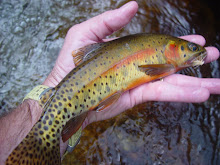
Shortly after, I caught a second. A little bigger - things were looking good:
 That second brookie is a typical average fish in almost every brookie stream I have fished in West Virginia, but at the risk of getting ahead of myself this would not be the case today. The next flat pool produced this guy:
 So it started, nearly every little pocket produced a fish and even the long slow pools produced brookies on a slow drift. I don't know if it was the overcast skies or the low 50-degree air temps, but the day was definitely one of my best (if not THE best) brookie fishing days in West Virginia.
  By this time I had easily hit double digits but my friend was still picking up a few here and there until he switched flies. I typically fish small flies for the brookies, and they produce, but when I saw what m friend had switched to I was amazed. He had switched to a very large (size 10?) grasshopper with a caddis wing and he was absolutely hammering them now.
The fishing was so good; when I stopped to have a bite to eat I did a little streamside dance. Apparently my little dance turned out to be a rain dance because the overcast skies had turned to rain and I had to put my DSLR in the dry bag and put it away. I still had my underwater video camera and it takes decent stills but it doesn't have the filters to reduce glare. It would service fine, notice the size of the fly:
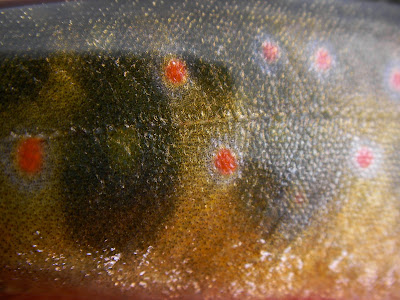
 The little palm-sized camera does take good macros:
 It also takes nice underwater shots too:
 And so it would continue, for over six hours we caught fish at an amazing rate. I would guess between the two of us we had to be pushing triple digits. The amazing thing was the average size. Most brookie streams I have fished have an average size of four to six inches; this stream average fish was six to eight inches with several fish over the ten-inch mark!
At one point, near the end of the day on this stream, we walked up to another long flat pool and bet a dollar on who would catch the first fish - second drift and I was a dollar richer.
A couple of things about this stream were the fish, not the size, but the color. We caught a few that were almost gold (excuse the glare - no filter):
 The last fish of the day for my friend had a strong gold tint to it. It's hard to tell in this photo, but you can almost see the monstrosity of the fly he was fishing.
 The other amazing feature of this stream was the resemblance (we both agreed) to Roaring River in Rocky Mountain National Park. Both streams have been absolutely scoured by floods. Minus the hardwoods you can see resemblance of the streams
 Roaring River in RMNP:

 With the rain continuing, I chose to leave the DSLR in the car. It's a shame because this little stream had some beautiful moss-covered rocky runs of many little brookie streams I have fished.
As we moved upstream, picking the favorable looking pockets to hit, I found that that second fish was an anomaly. This little stream produced some nice little fish:

 We fished for a little while, just long enough to validate a healthy brook trout population - as I do with most of the streams I explore.
On the way out I took some video of the stream as it goes underground, comes back out, gathers momentum, and sinks back underground for good.
The stream goes underground in an almost toilet bowl fashion:
A couple hundred yards away, the stream seeps back out and starts to gain momentum.
Shortly after it gains momentum it goes back underground for good. You can't tell from the video, but I am standing about twenty feet above this large sinkhole. I am also just about level with the top of the cascade.
By the time we returned to the car the rain had stopped, so it was on downstream to the stream that is rumored to contain reproducing populations of brookies, browns, and rainbows.
When I last saw this stream it was running chocolate milk. What would the recent rains do to the stream this day? Apparently this stream has had recent logging done in the extreme reaches of it and again the stream was running off-color. It was not complete chocolate milk but off-color enough that it was still fishable.
I started out with the small, 18 elk hair caddis but the heavy canopy and the colored water made it very difficult to spot - even on drifts of only ten feet. I soon changed to a high floating, size 18, yellow stimulator.
It took a while but I finally moved a fish. I stung him pretty good but could not tell what type of fish it was. A little while longer, I stung another fish and again I could not tell what it was. Shortly after this my friend's skirt flew up in his face and he made the decision to switch to a small wollybugger and fish his way back down and out. I can understand as scrambling over large rocks and downed timber was difficult enough in shorts - but in a skirt it must have been nearly impossible.
It didn't seem very long after he turned that I finally made a solid hook up and I was only slightly surprised that it turned out to be a nice stream-born brown. What was surprising was the size of the fish for the size of the water I was in. This was a good twelve-inch wild brown in a very small pocket of water.
 I ended up stinging a couple more and picking up a total of four wild browns. These wild browns had some amazing features. The adipose fin on this one was blood red and the main rays of the caudal fin were also a brilliant red. The heavy canopy made photos with natural lights nearly impossible, so I used the built-in flash which, flooded out the colors.
 I thought I was going to strike out on the other two species, but I was able to pick up this little guy before I finished.
 I had climbed a considerable distance when I decided the scramble out would not be worth any further climbing. I did not catch the third species, the brook trout, but then again I've never had much success fishing for brookies in seriously stained water. I'll keep this stream on my list and hit it again when I can find it running clear.
After the soreness I woke with and another tough scramble in, I was done. My friend wanted another shot at the main branch, so we went to an old railroad trestle where I stood up above and heckled as he fished for very educated fish. He was able to pick up one nice rainbow on some type of streamer pattern before he had enough - again.
He was not done fishing so I took him to another stream I fished two weeks prior. In the short period of time I fished this stream it produced both a brookie and a small stream-born brown. Today would be different, no brookies to hand but I did spook a few. We fished a short distance upstream without luck, but to avoid another scramble out we turned for the vehicle in short order.
Before we hit the main branch on the way out, I hit a small pool just above the mouth and picked up a nice little stream-born brown.
 Even though we fought off rain for two days, it was a great time to be in the mountains of West Virginia. The state flower, the rhododendron was blooming everywhere.
 The blooming rhododendron was just a bonus on top of the memorable day we had on the first stream.

 It didn't take long to verify a decent brookie population in this stream, both above and below the limestone fines dump, but again no photographic proof. With visual verification of the first two streams on my list, I headed back to camp to wait on my company.
 With the fishing slow and nearing dinnertime, we headed back to camp to grab a bite to eat before hitting another stream.
 The fishing continued to be good for the remainder of the afternoon, for two of the three of us. My friend with the most experience on this stream (no names to protect the guilty) went back to camp with the smell of skunk.
 The water was low and the pockets small, you can see in the above photo there wasn't much water. I continued up the trickle and the sound of moving water grew louder as I continued upstream. After less than a quarter-mile I ran into the source of the moving water and at this point the gradient of the stream changed SIGNIFICANTLY.
  What I also found was a good bit of this water was tumbling down and straight underground - the reason for the lack of water near the mouth.
 After I released the brookie, I noticed a trail above me, which seemed a fitting opportunity to head out. I'm not sure one brook trout constitutes a population, but with the reports I have received I have to believe the population is in good shape.
 I continued upstream until I ran into this wonderful site. The stream was low gradient to this point so this came as a surprise (although I was told to look for it).
 After climbing up and around the falls the gradient changed, not as significantly as the stream from the early morning, but it definitely changed. What also changed was the fish population. Typically a set of falls of that magnitude would act as a fish barrier for invasives and protect the native population. You can understand my amazement when the first fish I picked up was this guy.
  As I climbed upstream, I continued to pick up little rainbow after little rainbow - in nearly every pocket. The only other place I have fished with a population of little, wild rainbows like this was back in 2005 on the Middle Prong of the Little River in Great Smoky Mountain National Park. The recent droughts had obviously not affected these little guys!
 I continued to climb up this beautiful little stream, with moss-covered boulders and beautiful little plunge pools, all the while picking up little rainbows in nearly every pocket. Had it not been another solo adventure and a limited amount of water I could have fished this stream for an entire day. But again, caution got the better of me and I decided to head back out giving me plenty of time to get back to the vehicle before dark.


 The next morning would not be as early and it would not include rain. It was early enough to get in a little fishing before making the long journey home.
 I fished for about fifteen minutes and nearly hit double-digits. I would say the population in this stream is doing just fine.
 Again, in just a short few minutes on the stream we were able to verify a healthy population of brook trout. With this final new stream under my belt, it was time to call it a weekend and head for home.
 I missed one more strike before we were again on the trail in search of our partner. Again, we found another nice looking run but no fishing partner. By this point I was done looking for anyone, Ross and I were ready to concentrate on fishing. We fished through several nice looking runs and all I could produce was one small brook trout.
 I have been told the common name is Hemlock Varnish Shelf and the photos do not do the actual colors justice.
 As we neared the trailhead Chad decided to do a little more fishing while Ross and I headed back to camp. When we returned to camp, we found another pleasant surprise. The Forest Service employees had gone and cut us enough firewood to supply us for a week's worth of fires!
 When Chad returned to the car he reported good numbers of the wild browns while I reported good numbers of yellow and lime sallies.


 When I returned to the vehicle I was told I could have taken a much easier photo of the azaleas across the road on the edge of the wood line. Thanks for pointing that out ahead of time.

 This would be the second stream of the weekend to support both native brookies and wild, reproducing brown trout.
 We decided to try our luck on downstream, but we would not have the same luck as Chad had the evening before. We each moved a few fish and I missed a decent little brown, probably in the 12" - 14" class. While we were moving upstream, we had to continue to wake Ross as he was trying to take a nap on the streamside rocks.
 As usual when fishing with Ross, he wants to be the one to release anything caught.
 After this fish we called it a day....a long, rewarding day.


 After Ross landed a couple of brookies he became the expert, offering advice to Chad and me. It was the most Ross had talked all weekend and he even let me catch one.