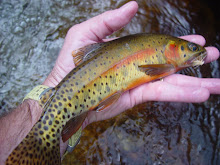
Since we were nearly in Oregon when we caught the Warner Lakes redband, why not hop across the border and pick up a couple more?
We stopped in Lakeview, Oregon to buy license and a gazetteer. The license was no problem at all, but when I asked for a gazetteer at the True Value they didn’t know what I was talking about. Luckily, another customer pointed me to a gas station on our way out of town.
We stopped to get gas, which by the way, you can’t pump your own gas in Oregon. How strange! Regardless, when I asked the gas station attendant if they had a gazetteer his response was exactly: “A gaza what?”. I probably should look elsewhere, and I did with no luck. We decided to press on without the aid of a gazetteer. I had my GPS and I had made very good notes on how to get to the streams.
Turns out we didn’t need the gazetteer. We drove right to the first stream – across 20 miles of washboard gravel road. I strung up the rod first and had my first Catlow Valley redband from the first open pocket.
 When I say “open”, I mean in the sense that you can get a fly on the water through the extremely dense trees. Nathan struggled a bit but also managed to pick up his Catlow Valley redband. I was lucky enough to pick one out of the first open pocket and it’s a good thing. This was some of the toughest fishing conditions I have ever encountered. You couldn’t get into the stream, it was that tight and there were very few openings in the brush. It was amazing to even find water, as the only thing we saw going into the stream was sage – NOTHING ELSE!
One of the locals, at the hot springs, told us we could get into larger trout on upstream around the corral. We started to check it out but we wanted to get to the next stream, so we passed.
We managed, again, to drive right to the next stream too. This was a special stream and one we were both looking forward to. This stream happens to contain the only (genotypical) population of the Alvord cutthroat, which up until a couple of years ago was thought to be extinct. I believe Gary is the first individual to validate the existence of the Alvord in this stream.
Gary gave us the exact location of the stream to fish and we immediately started picking up fish, but they were introduced Lahontan cutthroat. I caught a couple of very nice Lahontans, but that was not what I was after.
 Nathan did finally pick up one fish that displayed the external characteristics of the Alvord but all I caught was more Lahontans. Don’t get me wrong, it was nice to catch those fish but that’s not what I was after.
I had never caught a Lahontan cutthroat until this year and now I have caught them in three different states (NV, CA, OR).
I fished the stream hard but it just wasn’t meant to be and, besides, we still had 40 miles of rough, gravel road ahead of us to get out of there. At this point I had caught five different sub-species this day and I was then 10 of 12 on my trip list. Nathan had also caught five different sub-species for the day but he was now 11 for 12 on the trip list.
As we got about two miles from where we planned to camp on the Donner & Blitzen River my low tire indicator light came on. I pulled over and sure enough one of the rear tires was flat. Like a veteran NASCAR pit crew we changed the tire with enough time to get camp set up by dark.
The next morning it was up the Donner & Blitzen above the campground for the Harney-Mahleur Basin redband.
 I picked up another in a nice little pool, which was covered on both sides by overhanging trees.
 Nathan fished hard and finally picked up a couple of decent fish. The count for me was now 11 for 13 (10 new species) and Nathan was up to 12 for 13 (all new).
 It is so much fun sight fishing to these guys, as they stick out like a sore thumb.
 The Colorado state record for grayling is 17"!
 I didn't fish long, I just wanted Nathan to catch some grayling. I know he wanted to get some good photos of grayling and his bamboo rod...and he did.
 It had been two years since I had been in this area and it was depressing to see the bark beetle had made it north of RMNP.


 The drive across Tioga Pass Road was amazing enough, but I wanted to see Yosemite Valley and all it has to offer. The plan was to find a motel room some place near Yosemite Valley where we could shower (#2 for the road trip) and find a bed (first time on the road trip). I think this may have been the only leg on our trip where I should have planned better and didn’t, as it took nearly 40 miles of following the Merced River to find a hotel room in our price range. For $80/night we found a room in Muir Lodge with two beds and two TV channels – and they were the same channel. Most importantly, though, they had hot showers and beds!
 I wish I had a dollar for every time we were asked on the way down if we had already been up and back to Half-Dome. I’ve seen pictures of the conga line going up Half-Dome, and from the crowds it looked like another busy day. However, from the condition of some of the folks we passed I don’t think half of them were capable of making it.
 In preparation, and in interest of his works, I have been reading a collection of John Muir works. His presence is everywhere in the valley and I couldn’t help but wonder what this valley must have looked like before it was developed.
 The haze had moved into the valley early and the shots of Half-Dome did not turn out as well as I would have liked.
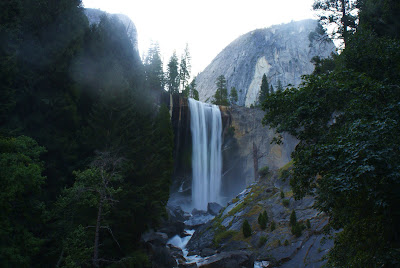
 On the way out of the valley, it was one last stop at Bridal Veil Falls. I should have stopped on the way in! By the time we made it to the undersized parking lot it was a game of musical chairs for a parking spot. I finally found a spot along the road but by the time we made it to the base of the falls the sun was at the perfect declination that you couldn’t see the top of the falls for the glare. I made one more lap around the short loop and finally got a decent shot of Bridal Veil Falls and Cathedral Rocks.
 From the valley it was back across Tioga Pass Road. Before we left, I got one last glimpse of the amazing Yosemite Valley (you can see Bridal Veil Falls in the bottom center).
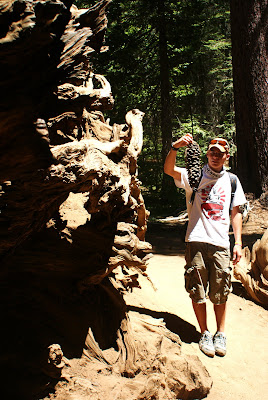
 Our first stop on Tioga Pass Road was the sequoia stand. I had never seen one and I could not believe how big they were.
 Even the pine cones were big.
 From the stand of sequoias there was only one more stop. Nathan had scoped out a small stream he wanted to fish before we left Yosemite National Park. I didn’t plan to fish; just soak my feet in the nice cold water. The first fish Nathan pulled out was a nice 10” brookie. Needless to say it didn’t take me long to string a rod up in an effort to add another state to my brook trout list.
 After completing my Yosemite Slam, it was back down to Rt 395 then north where the plan was to set up camp at the trailhead for our trip into Silver King Creek. Again, along 395 we stopped at a little road-side restaurant for a meal. This one happened to be south of Coleville and the fair was barbeque. Maybe it was the fact we had been living on college food for over a week but this was also some of the best bbq I had ever had.
 The next morning we met up with Dave and completed the hike into the open water section of Silver King Creek. We fished the open end of one of the tributaries that were reported to have Paiutes, and we also fished a couple miles of Silver King proper. You won’t see any photos of Paiute cutthroat in this entry as there were none caught. We did catch MANY rainbows in the 8-10” class and they were impressive rainbows at that. I don’t know that I have ever caught so many high-flying trout. I had several of these small rainbows jump three feet out of the water before they were landed.
 The meadow itself seemed to be only in late spring with all of the wildflowers and it was actually the first day of August.
 We both caught several Lahontans with the largest being about 10”. The size didn’t matter, though, this was species number four for our California Heritage Trout Challenge – we were over half-way there.
 The hike out seemed short, maybe because the three miles was the shortest of our hikes, maybe it was because it was our last hike of the trip, or maybe because it was the beauty of the high meadow trail.
 From this trailhead it was west to Sacramento then north to the shadows of Mt. Shasta. I’m just glad we weren’t staying in Lake Tahoe that weekend. We were going west but the traffic going east was bumper-to-bumper for over thirty miles!
 I was a bit late for the yucca bloom, but there were still a few out there:
  As I gained altitude, the Joshua tree became more prevalent and I took this shot of a fine specimen in the low light of the early morning.
 I finally made it to water and made one stream crossing. When I made it to the second crossing, a little deeper, I decided to get out to inspect the crossing a little closer. I think I could have crossed but on the other side the road turned to a second channel of the stream. I was almost 90 minutes from hard road and solo, so I decided discretion is the better part of valor and I parked and made the final hike to the trailhead on foot.
 My first desert trout, a Lahontan cutthroat, and my 8th cutthroat species added to my life list.

 When I got to a section of stream where the canyon choked down, I sat on the pool at the bottom of the canyon and picked out cuttie after cuttie. I probably landed over ten fish from this pool - and missed nearly as many...typical cutthroat fishing.
 The DOW agent informed me to be very careful when working along the stream banks as it was nearing snake season. With this warning and no easy way to move on up the canyon, I decided to call it a day. I had completed my goal, with several Lahontans landed, and I had another adventure ahead of me with the drive out.