Saturday, May 28, 2011

And Sometimes it Rains!

April was one of the wettest months in history! In the Cincinnati metro area we were 3/4" of precipitation away from the all-time record...and it continued into May.

This weekend outing back home had multiple goals. It was the WVCTU Spring Council Meeting, the Blennerhassett Chapter Campout, the WVCTU Fly Fishing School, and my annual outing into the Seneca Backcountry with my WVU Professor friend.

It was one busy weekend and it started with a 4-hour drive to WV then, after waking at 3:15 AM, another 3-hour drive to the trailhead. Unfortunately, it had rained several days prior and was raining as I met my friend.

You can see from the USGS Water Gauge (normal flow of 300 CFS), we were 4X the normal flows!


As opposed to making the ~ 10-mile trek we chose to explore new water on the other side of the mountain. I had fished a number of streams in that area which my friend had not. The only thing better than exploring new water is sharing it with a good friend.

The first stream we stopped at has had major work done to it over the past few years, including tree plantings and livestock fencing in the headwaters. From the bridge crossing the stream has two very distinct profiles. Upstream it is a lower gradient stream, meandering through large hemlocks and open, high meadows.


This section of stream reminds me of Tonahutu Creek in Rocky Mountain National Park, just above Big Meadows. Both are equally beautiful!


Downstream from the bridge it takes an entirely different profile. It is a high gradient, plunge pool type stream that is my preference when chasing the natives. You'll have to excuse the quality of the photo, I was using my waterproof video camera...did I mention it was raining?


The water was moving pretty good and we managed to pick up a couple of small brookies (sorry no photos), so we decided to try another of my favorites in this major watershed.

We drove the short distance to the trailhead of another stream that originates in Virginia and flows through West Virginia before meeting up with the Potomac. By the time we made it to the trailhead it had stopped raining, but had the damage already been done?

Instead of hiking to where the trail meets the water, we barreled down over a steep embankment to the water and almost immediately started picking up fish. The water was up a bit and still moving pretty good but it did not prevent these small jewels from coming out to play.


Then magic struck! As we made it to this large, green pool the big boys decided to come out to play...on top!


I fished the tail out while my partner hit the head. I picked up two of these nice specimen (on top).


Then, as I was standing and watching, my partner picked up this big guy - probably pushing that 12" threshold.


We continued to pick up a few fish here and there as the water continued to rise from earlier storms. The sun also played peekaboo with us on and off and every time the sun would come out heavy hatches of yellow sallies would come off - what a great time to be on the water!

By the time we decided to call it a day, the water was up to the point the only place we could find to cross was crotch deep and ripping. It made for an interesting crossing with a DSLR camera around my neck, but I made it.

The other great thing about spring: the wildflowers are out and the critters are awakening. I found this Jack-in-the-Pulpit streamside.


This little guy also met us on the trail for the hike out.


He's a harmless black rat snake but I wouldn't recommend this trail in the heat of summer. It is one of the rockiest, snakiest trails I have ever been on and it's located in Timber Rattler Central!

Following a great evening with good friends around a campfire, day two included the State Council Meeting and the Fly Fishing School. The question was: where do I fish before the council meeting?

I had marked several tribs of the upper West Fork of the Greenbrier fr exploration, so today would be the day. I thought that with a couple of hours to fish I could hit a couple of them...until I actually made it on this first stream.

In the lower reaches the stream flows through a beautiful high meadow before transitioning into the hardwoods. Over 100 years ago this was home to a logging community and there are still remnants of this.


The recent rains seemed to have passed through this small stream already but I still only moved one fish in the meadow. Once I got into the section of stream with good canopy it was a different story.

Sometime since the logging had stopped, somebody had done some major instream work on this stream. There were standing K-dams, log dams, and log re-routing of the stream. The little brookies seemed to appreciate all of the hard work.


It's always good to see the little guys in the stream too.


The fishing was so good and seeing the amount of work done on this stream was amazing. Add another WV stream to my life list. Needless to say, I didn't make it to any other tribs before I had to head over the mountain to WV State Council...too much water, too little time.

I had been anticipating State Council for weeks now! Not for reasons you would expect, but because I would get the return of my Vandalia bamboo #003! I had broken the butt of this rod the previous summer while chasing (unsuccessfully) Paiute cutthroat on Silver King Creek. Phil Smith, the rodmaker, was replacing the reel seat with a piece of 2,000+ year-old bristlecone pine we had picked up during our 2008 Colorado Cuttslam trip.

Following State Council it was back across the mountain for a presentation at the WVCTU Fly Fishing School. What was my presentation? Travel planning and native species, of course.

It was another great evening with great friends around the campfire.

The next morning it was goodbyes to old friends and decision time again. Back to the headwaters of the WF of the Greenbrier? A couple of friends had fished another small trib the day before and recommended it and it was on my route home.

Once on the stream, it didn't take long for #003 to return to form....the return of #003!


As always, it's good to see the little guys in there.


With over seven hours of driving ahead of me, I spent only enough time on the stream to validate a healthy population of brookies. Add another stream to the WV life list, then it's Cincy bound.

Before I could make it to the hard top, I ran into one more of the natives. This grouse wanted to play chicken!


Although the rain put a damper on day one, it was a great weekend with great friends! I can't wait until my next trip "home", I'm going to do something I've wanted to do for years. I'm going to take a week of vacation and stay home in West Virginia - backpacking through the Cranberry Wilderness area.

Until next time...

Chris

Saturday, April 30, 2011

Father & Son Spring Break in the Smokies - Third Annual

This was the third annual father & son trip to the Smokies. In 2009 we were shut out due to high water and in 2010 we had our plans changed three times, in three days, due to road construction. What would the 2011 edition have in store for us? I had to wonder as we left severe storms in West Virginia and drove through multiple hail storms on the way to Pigeon Forge, Tennessee.

We left West Virginia, and the Elkhorn Clean-up, a day earlier than planned due to storms and high water but this would give us an additional half-day to fish the Smokies.

Day 1

We tried to fish this stream last year but a trailhead closed for construction changed our plans. I read about this stream in Jim Casada's book and had to fish it as it was one of a few streams he rated as "A". Most people will recognize the stream's confluence with Little River.


It is a short couple mile hike up and over the mountain to the stream, with the trail following and crossing the trail multiple times. My concerns of high water were quickly put to rest as the stream level and flow was perfect. We didn't find any brookies at the first crossing so we jumped on the trail and started again at the second crossing.

I picked up my first, little brookie just below the crossing while my friend worked the upstream section of the crossing.


After verifying their existence, it was time to focus on my son's first brookie of the trip. The next series of photos are of my friend assisting with the drift, the hook-up, and the landing of my son's first (of two) brookies on this stream.


We continued to pick up fish at nearly every access point, including one nice brookie caught by my friend (sorry no photos). We fished upstream to where it appeared to take a turn straight up - high gradient, my type of fishing!

Unfortunately, my son and friend decided it was time to head out. I tied on a small olive woolybugger and dredged one of the first, deep plunge pools while the others changed out of their waders (it was nearly 90 degrees by this time). I hooked a very nice brookie, in the 10-12" range, but I didn't get it to hand.

We stopped at one of the crossings on the way out so I could adjust my son's socks and wading boots. While I was adjusting my friend rose a brookie that he said "was as big as his boot". Why are the brookies in this stream so big? I believe it is because they are a transplanted northern strain of brook trout, planted in the early 70s.

We did have a slight mishap as we got within shouting distance of the trailhead. My son's boot laces got tangled and he went down on a sharp rock in the trail. It put a pretty good gash in his knee and covered his face in mud. When we got back to the vehicle, he was a trooper! He squeezed my hand and gritted his teeth while we cleaned and bandaged his knee. I think what really helped was the trip to Little River Outfitters. He picked up another lucky hat, a fly box, and some assorted flies to fill the box - he quickly forgot about his knee!

Following our quick stop in at the fly shop, it was over to Cade's Cove and Abrams Creek. My friend and I are a bad partnership, he likes to fish the big water and I like the little stuff. To be fair, I took him to Abrams but the water here was up and flowing pretty good, but it's always nice to make the drive around the Cove.
Day 2

Our second day in the Smokies would take us to the North Carolina side and another location we couldn't get to in 2010 due to closed roads. Our plans were to head to the Cataloochee area so my son and I could hike Boogerman trail while my partner fished Palmer Creek. I also wanted my son to see his first elk.

We dropped my partner off just downstream of the Palmer chapel and my son and I headed to the trailhead at the mouth of Calwell Fork.

Crossing the Cataloochee:


What 10-year-old doesn't want to hike the Boogerman Trail?


Boogerman Trail winds itself through some old-growth forest before meeting back up with Caldwell Fork nearly four miles later. I will (eventually) detail this hike in my other blog outlining my hikes across terra firma.

We passed an old homesite before meeting up with Snake Fork. You could step across Snake Fork but it just looked "fishy". A quick dap of an olive EHC and, yes, Snake Fork has brookies.


We eventually made it back to Caldwell Fork and the trail by the same name. We were getting pressed for time, we had almost three miles back to the trailhead, but we had time to fish at a couple (eight total) of the bridges. I expected rainbows but all we caught were more brookies - no complaints from me!


We made it back to the vehicle, loaded up, and went to meet our partner. We found him fishing Palmer along the road where my son wanted to give it a shot at the run he was fishing,


A quick debrief of my partner and I learned that all he caught were brookies, in both Palmer and Pretty Hollow. Good news but confusing, I thought all he would catch were rainbows with the possibility of a few browns.

With Boogerman and two new brookie streams under our belt, it was time to find the Cataloochee elk herd. It wasn't too difficult, and we even found another group of turkey - not that that is a difficult task in the Smokies.


We stopped on the Lower Cataloochee, just above where Little Cataloochee Creek dumps in, so my partner could try one more time for that elusive brown trout.

He struck out again but the quick stop wasn't a complete loss. I got to see my son decide he was going for a swim. It was in the upper 80s, but it was still April, and this is still a trout stream. I laugh every time I see his face when he hits that cold water.


We took the scenic route out of the Catalooche drainage, across Mt. Sterling gap to Big Creek and I-40. We made one last stop for the day, at the Cosby overlook on the Foothills Parkway.


Day 3
 
After low 90s on Sunday and upper 80s on Monday, Tuesday was much different. The temperature this day would not surpass 45 with a steady rain all day - even snow flurries and 37 at Newfound Gap.
 
The original plan or this day was Leconte Creek and a hike to Grotto Falls - another location we could not get to last year due to road closings. With the rain and the fact my son found out he is not as fit as this time last year, we decided to do some "road fishing" this day.
 
We decided to head up and over Newfound Gap, back to the North Carolina side, and the upper Oconaluftee River. I thought this might be another opportunity for my friend to pick up a brown.
 
The rain had the stream up, but fishable. It was cold, even I put on waders. We fished for a short period before my son wanted to get back in the vehicle to warm his hands. The first spot did not produce but the next stop at the Kephart Prong trailhead produced a couple of rainbows on a large stimulator stripped like a steamer at the tailout of a drift.
 
 
My partner struck out on his quest for browns (or anything for that matter) on "the luftee". We decided to head back to the Tennessee side so he could give the Little River a try at Metcalf Bottoms.
 
A good friend at the Elkhorn Clean-up told me he had caught little bows behind the Sugarlands Visitor Center in Fighting Creek. We had to go by there to get to Metcalf, so why not?
 
I caught this little guy under the nature trail bridge.
 
 
Little River was raging so he struck out there too. Even though my partner had gone fishless for the day, it was time to call it a day. We took another alternate route as I had never driven from Metcalf Bottom to Wear Valley. I had know idea it was that close! It had to have been nearly 30 minutes quicker than going to Townsend then back to Pigeon Forge.
 
Day 4
 
Day four would be our last and shortest day of the trip. It would be a quick stop at the Cosby entrance before heading back across the Foothills Parkway, then north to West Virginia.
 
Cosby Creek is a nice, little, roadside brookie stream. It is nice pocket water with a few small plunge pools mixed in. I'm not sure why the brookies didn't want to cooperate, they're in there, but I only picked up one brookie in the short time we fished.
 

After a quick hour, or so, of fishing it was time to pull the plug on the third annual father/son trip to the Smokies. We took our gear off and packed up, but before we headed north it was time for our gratuitous entrance photo.

 
We made the decision that every year we would take this photo at a different entrance sign.
 
As I took the time to go through all of the photos I realized that I did not take as many photos as I normally do. I blame it on rust from the long winter. I need to force myself to take more photos, particularly when I have my son with me!
 
He took a few photos on this leg of his spring break too:


It was another great father & son outing in the Smokies!

Chris

Saturday, April 23, 2011

Elkhorn Clean-up 2011

Well, after a very long and eventful winter I was finally able to get in some REAL fishing....and it's April!

This event is an annual TU outing for me. Unfortunately it just happened to be the first "real" outing of the year. Fortunately, though, it coincided with my son's spring break and our annual trip to the Smokies - so this would be my son's first Elkhorn Clean-up.

As with many spring outings you must dodge rain and high water, and I've only attended one (of five) Elkhorn clean-ups where high/fast water was not a factor - an this year was not one of them.

We arrived on Friday for the Saturday clean-up, which gave us a full day to fish THE best wild trout stream in the state. In the last 4-5 years, this is the only time of the year where I fish a West Virginia stream that is not a "native" stream.

The flow and the levels were up in the main stream, so it was tough fishing for my son and I. We made the decision to move up one of the tribs...and it was fish on! I caught three of these guys in about five minutes.


I picked up a few more little guys before we made it back to the campground for the annual Friday night dinner and festivities.

We almost made it through dinner before the rain started and we also got a campfire started before the real storms hit! My son and I piled in the camper when the massive storms hit: thunder, lightning, and hail! Our host said that those were some of the worst storms he has ever encountered in a camper.

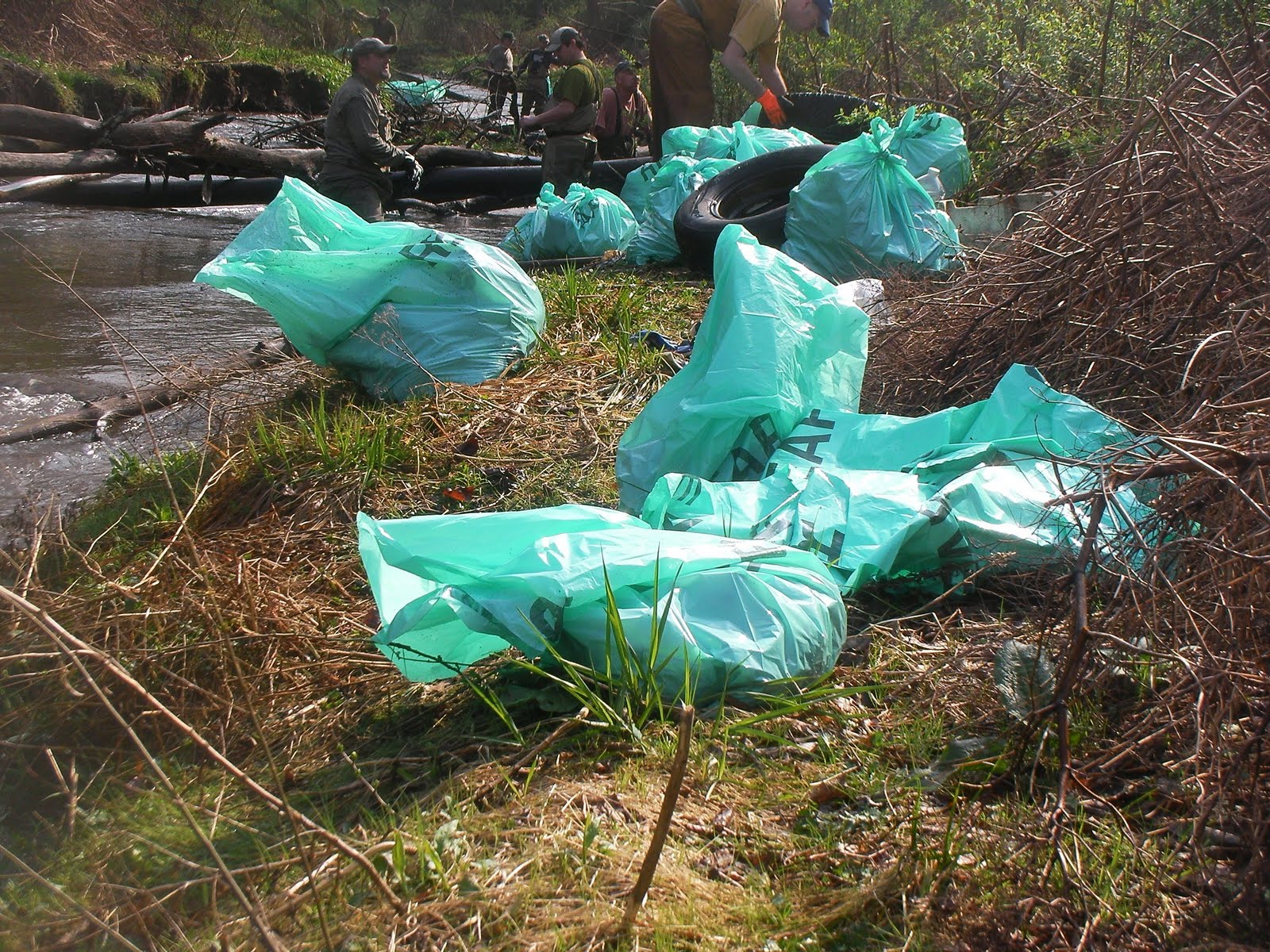
The next day was the actual clean-up and the numbers were down again this year. We had ~100 volunteers in 2009, ~80 in 2010, and just over 60 this year.


The numbers were down, but it also appeared the trash was too. It may have had something to do with the high flows and storms - most likely it was swept it on downstream.

Before:


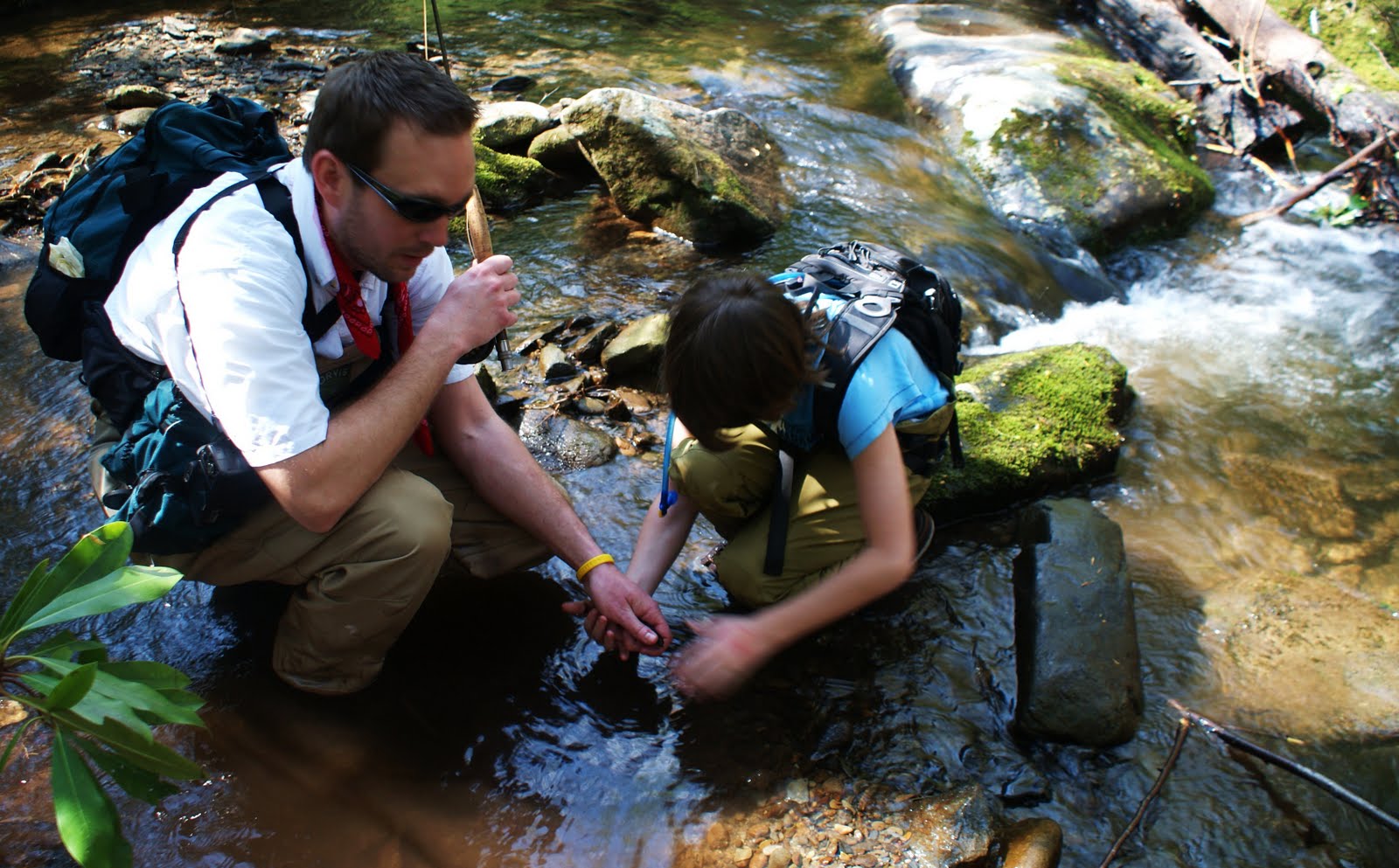
During (with my son right in the middle of it):


After:


Following lunch it is usually back to the stream but this year was different; we had high water, forecast for more storms, and plans to head to the Smokies. So, with all of that we packed up and headed south a day earlier than planned.

Next entries will be from our annual father/son trip to the Smokies but first I wanted to post some photos my son took. He likes to carry a camera too. He has already "dunked" one camera so I let him carry my waterproof and he doesn't do too bad. All of these photos were taken by a handheld, underwater, video camera:


Maybe it's just because he's my son, but I think (for a 10-year-old) he does pretty good with a camera.

Chris

Monday, March 28, 2011

Alvord Cutthroat - A Call for Action

As anybody who has followed my blog knows, not only do I post my adventures in search of native salmonids I also use this blog as a platform to raise awareness on the efforts to restore some of these native species.

This is another opportunity to voice your support of an improvement effort. This time it is for the "extinct" Alvord cutthroat. My friend Gary Marston of Native Trout Fly Fishing made me aware of this effort a couple of weeks ago and today he sent me this information.

This is a phenotypical Alvord specimen Gary caught (borrowed from his website):


The Alvord cutthroat has been declared extinct for most of the past century, however in one small creek in Southern Oregon there is still a remnant of these fish left. Although it is unclear how genetically pure the fish in this creek are, some are phenotypically correct representations of the Alvord cutthroat trout and this may be the last chance to save these fish from extinction. The problem is that closely related Lahontan cutthroat have also been stocked in the creek and the greatly out number the Alvord type fish and seem to be slowly but surely replacing the Alvord type fish. For more information of these fish, please visit http://kortumofdiscovery.wordpress.com/ or http://www.nativetroutflyfishing.com/alvordcutthroat.htm.

 
I fished this small creek on August 1, 2010 and did not land one of these phenotypical Alvords but my partner did. All I caught were the introduced Lahontan cutthroat.


I want another shot at them and we need to ensure they survive/thrive for me (and possibly my son) to add them to my life list.

 
Here is some information on current efforts and what you can do to voice your support:

 
A number of “challenges” attempt to inhibit ODFW SE Oregon Fish Biologists—at least where the Alvords are concerned. They have a lot on their plate, and much of it essentially mandated. At this point, the alvordensis phenotype consideration is completely volitional. The remaining known streams in the Alvord Basin that can support trout have had Willow/Whitehorse Cutthroat Trout translocated to them. Other streams might be “salvageable” if riparian zone work was accomplished, and perhaps beaver reintroduced into those streams. There also seems to be an expectation that they cannot get funding for a project without genetic “proof” that these are alvordensis. Of course, this inevitably leads to the complications Dr. Behnke predicted. Like many native trout enthusiasts, we hope that action will be accomplished before it is too late…

 
There’s a fair amount of “mystery” involved in this situation—and some have interpreted this into skepticism. The “true believers” tend to be those that have spent some time on the stream and have experienced the trout first hand—with an observant perspective of inquiry: “what is this?” and “where did it come from?” Common sense would lead one to comprehend that there are a finite number of explanations—and what Dr. Behnke has put forward indeed is the most likely explanation. Of course; none of us would have any traction without the authority and statements published by Dr. Behnke…

 
There’s more we may chat about in the future providing that time and circumstances permit… We’d be interested to know the level of genetic studies that you may have undertaken in the pursuit of your fisheries biology degree (there’s some background that brings this question to mind). I’ve been looking into the prospect of furthering ichthyologic biology and genetic studies simply because it seems alarmingly evident that some genetic studies/conclusions are missing a broad element of common sense.

 
Currently there is a “waiting game” underway—Mary Peacock of UNR ostensibly waiting for funding from the US Fish & Wildlife Service before she undertakes the project to look at the dozens of pre-hybridization specimens, along with the more recent specimens. More could be said about this than time permits—but this is the course of “action” that TU seemed to consider logical; and partly, for lack of funding, has gone on and on. There are samples from 2004 and 2008 that may be appropriate to analyze along with the select few from 2010—but, we personally have notable concern regarding whether genuine objectivity will be applied in the thought processes involved.

 
As you may know; Dr. Behnke has already pretty well spelled-out reality: “The best advice I can give I borrow from Peter Larkin’s keynote address to AFS many years ago: “Simplify, simplify, simplify”. The goal is to create a population of trout phenotypically representative of the extinct alvordensis by selecting specimens from Guano Creek that most closely resemble alvordensis. These would be transplanted into presently fishless waters. If all of the proposed actions, especially “genetic testing”, were attempted to be carried out with all of the associated planning and funding, I doubt the goal will ever be attained. It’s human nature to put off until tomorrow what could and should be done today. Accept that Guano Creek trout are not pure, but retain the hereditary basis to phenotypically duplicate alvordensis. What can more and more genetic analysis tell us except that the present population is most likely the product of more than one parental population?”

 
Little has changed in the five years since 2006, except that remaining Alvord phenotypes may still be on the decline. Last summer, when sampling the creek—with Shannon, her field assistant, Trout Unlimited personnel, an OSU Fisheries Professor and Patrick Trotter; eleven of fifty-five trout were logged as Alvord phenotypes (for a 20% or 1:5 ratio). In reality, that number was exceptionally high. The real number of respectable Alvord phenotypes is almost certainly a notably lower percentage, and the more time that goes on, the more likely it is that there will be greater difficulty in securing meaningful phenotypes for preservation of Alvord characteristics for future generations to experience and appreciate.

 
Writing a positive and encouraging letter of support to Shannon would be a good thing. We believe that as well as being a tool she can utilize in requesting grant funding from the Western Native Trout Initiative, etc; she also could use positive encouragement herself in this regard.

 
A letter of support might ideally include the mention of a number of considerations:

 
  1. Possibly changing the regulations to “catch and release” only (currently allows a take of two trout per day), or some similar restriction…
  2. A gentle reminder of the facts as Dr. Behnke has related them, and that genetic analysis tends to be a delay—and for what purpose? And to what end?
  3. Creating sustainable habitat for the Alvord phenotypes (riparian zone work, doubtless, should be a priority for streams that could, with help, sustain trout). 
  4. If you believe it to be the case—expressingalvordensis in the system seems to still be on the decline…
Please submit letters of support for an Alvord phenotype rescue and restoration project to: Shannon Hurn, ODFW District Office, 237 Highway 20 South/PO Box 8, Hines, OR 97738 or via email to shannon.m.hurn@state.or.us


Thanks,

Chris

Sunday, March 20, 2011

It's Getting Close

The long winter is nearing completion. Tomorrow is the first day of spring and my first planned fishing trip is less than three weeks away. I plan to kick off the season with the annual trip to the Elkhorn Clean-up then heading further south for our annual father/son trip to the Smokies.

I was able to get out once over the winter, with a quick trip to new water with an old friend. Due to my transfer and my friend's house building, we were unable to hook up in 2010. Last month, following the West Virginia winter meeting of TU State Council, we headed east about 45 minutes to new water for me. With heavy runoff and heavy flows, there were no trout harmed on this quick trip but it was definitely nice to just get out on the water.


The winter hasn't been a complete loss, I've been acquiring gear for the upcoming season. In addition to my son's first pair of waders and his first backpack, I also purchased a dozen unique flies from Ben of Arizona Wanderings blog. He calls them mini-hoppers and I can't wait to give them a try on some wild trout waters of the Smokies.


Here's to another great year in search of native salmonids.

Chis

Saturday, January 15, 2011

Restoring Native Salmonids in Yellowstone National Park

Yellowstone National Park, the nation's first national park and home to some of the world's most acclaimed wild trout fisheries, has developed a draft plan and environmental analysis addressing future protection and restoration of the park's native trout, including Yellowstone cutthroat trout, Westslope cutthroat trout and fluvial Arctic grayling.


The documents can be found at the following link:

 The Native Fish Conservation Plan and Environmental Assessment

The plan calls for drastic measures (rotenone) but declining populations of native salmonids in the park explain the drastic times we now find for ourselves.


The primary focus of the plan will be eliminating the lake trout from Yellowstone Lake, but there are also several smaller projects to restore westslope cutthroat and grayling to park waters. I have pulled some of the specific projects from the plan:

G.2.2.1. De Lacy Creek
Brook trout are proposed to be removed from De Lacy Creek with the use of piscicides, followed by a YCT restocking effort.


G.2.2.2. Elk Creek Complex
This project would remove BKT using piscicides with subsequent restocking of YCT.


G.2.2.3. Gibbon River (upper)
Non-natives such as BKT, BNT, and RBT are proposed to be removed in this section of river upstream of Gibbon Falls by piscicides followed by the restocking of AGY &WCT.


G.2.2.4. Goose Lake Chain
This project would remove RBT that were previously stocked in this historically fishless lake. The proposed project would utilize piscicide to remove the RBT from the Goose Lake chain, including all streams between the lakes, and replace them with a self-sustaining population of WCT.


G.2.2.5. Pocket Lake
Pocket Lake is proposed for removal of BKT by use of piscicide followed by a restocking of YCT. Not only would the entire area of the lake be treated, but the upstream tributary and downstream to the lower waterfall would be treated as well.


G.2.2.6. Clear Creek
For more than 50 years information concerning spawning YCT from YSL was collected at a weir on Clear Creek. The weir was located approximately 250 meters upstream of the confluence with YSL. In 2008, high water damaged the existing weir, rendering it inoperable. The NPS is proposing to reconstruct the weir in a fashion that would allow the weir to again monitor spawning YCT and would minimize impacts to hydrology and wetlands or waters of the U.S. and their associated values.


G.2.2.7. Grayling Creek
This project would remove non-natives such as BNT, RBT, and CTX by use of piscicide followed by a restocking of AGY and WCT. A small existing bedrock waterfall would be modified to ensure it is a complete barrier to passage by nonnative fish (rainbow and brown trout) as they attempt to move upstream. The waterfall is located out of public view in a steep canyon near Montana HWY 191, 15 miles north of West Yellowstone, MT. The waterfall is approximately 2 meters in height. A deep (1 m depth) pool (“plunge pool”) exists immediately downstream at the base of the falls. The falls is bounded by bedrock and boulders on both sides.


G.2.2.8. Soda Butte Creek
This project would protect remaining YCT in Soda Butte Creek upstream of Ice Box Canyon. In order to preserve native Yellowstone cutthroat trout in the upper reaches of Soda Butte Creek we would modify an existing bedrock waterfall to ensure it is a complete barrier to passage by nonnative fish (rainbow and brook trout) as they attempt to move upstream. The waterfall is located out of public view in a steep canyon (Ice Box Canyon) along the East Entrance Road, east of Tower Junction. Ice Box Canyon contains a series of small falls and cascades (each approximately 2 meters height) which are bounded by steep bedrock on both sides. There is one feature within this series of falls and cascades that represents a significant barrier to upstream movement of trout. However, a large crack in the bedrock has formed a chute that may be passable by fish under some flow conditions. Of particular concern is the west bank of the falls where a large crack in the bedrock ascends the falls creating a single steep (but potentially passable) cascade.
G.2.2.9. Specimen Creek
During 2006 – 2010 native westslope cutthroat trout were restored to the East Fork of Specimen Creek (EFSC) temporarily isolated from the remainder of the Specimen Creek watershed by a man-made barrier to upstream movement of nonnative trout (rainbow and brown trout). The EFSC fish barrier is a log structure placed in a remote canyon, 5 km from the trailhead at HWY 191. Although this work represents a significant advancement in the conservation of westslope cutthroat trout, the overall goal remains to restore the entire watershed (including the North Fork of Specimen Creek and the mainstem) extending downstream to near the HWY 191 road bridge. Upon completion of the watershed restoration, the EFSC barrier would be removed and the area rehabilitated to its natural condition.


To restore native westslope cutthroat trout to the entire Specimen Creek watershed, it would first be protected from invasion by downstream sources of nonnative trout (in the Gallatin River) via a permanent fish barrier constructed largely of concrete and steel. The barrier site is well within public view near the Specimen Trailhead parking area, 26 miles north of West Yellowstone, MT. The site consists of an abandoned road bed (old HWY 191) that intersects Specimen Creek approximately 75 meters upstream of the existing highway bridge and forms an existing low “dam” across the floodplain. Specimen Creek flows through a narrow notch in the embankment, where a bridge once stood. Analysis of this site using Hec-Ras hydrological modeling (White 2008) indicates that it is a feasible site for barrier construction. Bankfull widths of the creek average 9 meters at undisturbed cross-sections

You may not believe in poisoning one species to preserve another, but hundreds of thousands of miles of streams with introduced species will remain in Yellowstone and surrounding states. These planned measures represent a fraction of a percent of total fishable water.
 
Read over the plans and provide your comments in support of the plan by using the link below. From my TU friends in Wyoming and Montana:
 
Tell the Park Service:
You support its stated objective to make suppression of lake trout in Yellowstone Lake the highest priority action for native fish conservation in the Park;You support the Park's stated, measurable targets for restoration of the Yellowstone cutthroat population in the lake, as well as the objectives for stream miles to eventually be occupied by westslope cutthroats and grayling;Also, ask the Park to:Increase the time and resources it dedicates to lake trout removal to ensure the population of this non-native predator is reduced to numbers that result in a significant rebound of Yellowstone cutthroat trout numbers.


Employ rigorous monitoring to ensure the Park meets its stated objectives, and to implement important research projects that help the Park better understand where lake trout spawn and how they move about the lake. This important information will help ensure the Park achieves its objectives.

Implement the recommendations from a science panel the Park convened in 2008 to help guide its efforts on the lake. These recommendations can be viewed at: [www.greateryellowstonescience.org/files/pdf/Gresswell_FINAL_color.pdf]

Submit your comments today. Help Yellowstone National Park's world famous native trout.
 
Submit Your Comments Online

Thanks,
Chris

Saturday, January 1, 2011

#151

I recently received my certificate for completing the California Heritage Trout Challenge. Of the individuals to complete the challenge, I am number 151.


The species I submitted for the CHTC, all in their native watersheds, were:
  • Kern River Rainbow
  • Little Kern Golden
  • California Golden
  • Lahontan Cutthroat
  • Goose Lake Redband
  • Warner Lakes Redband
I also caught the McCloud River Redband, but I will save that one in case I catch the remaining species in the challenge.

This certificate will look nice with my Wyoming Cuttslam certificate.


The species I submitted for the Wyoming Cuttslam, all in their native watersheds, were:
  • Yellowstone Cutthroat
  • Bear River (Bonneville) Cutthroat
  • Snake River Cutthroat
  • Colorado River Cutthroat
Also hanging with the two official certificates will be my "unofficial", self-created, Colorado Cuttslam.


The three native species from Colorado, all in their native watersheds:
  • Greenback Cutthroat
  • Colorado River Cutthroat
  • Rio Grande Cutthroat
Happy New Year and here's hoping 2011 brings a Wyoming and Colorado Cuttslam for my son.

Chris